On September 10, 2026, Bentonville welcomed 200+ senior leaders for the fifth edition of the Retail Innovation Forum, offered by dunnhumby ventures as the annual regional convening of the Retail Innovation Network. Attendees included a powerful mix of retailers, CPGs, big tech, investors, accelerators, and tech startups, with 90%+ of attendees at CXO, GM, or equivalent level and 55% first-time participants.
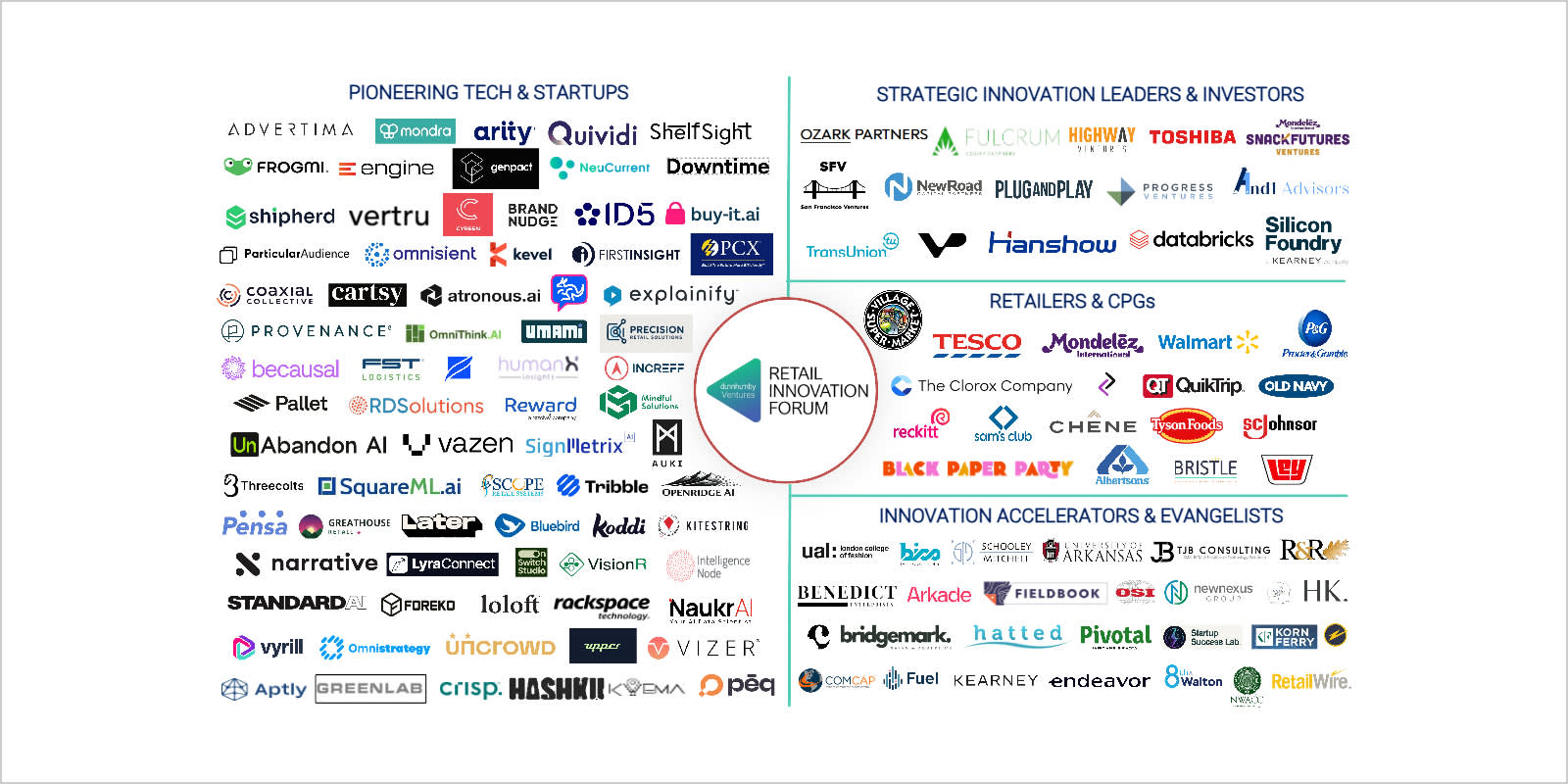
Retail is evolving faster than ever, and many of today's challenges extend beyond any single company. Not because of a lack of capability, but because the challenges themselves traverse multiple nodes of the network of players that makes retail function. They cut across retailers, brands, technology providers, investors, and startups, making collaboration increasingly more important as each brings a distinct perspective on the industry.
The Retail Innovation Network exists to bring those perspectives together by creating a space where those viewpoints can be shared, challenged, and connected. This year's discussion centered on a simple question: What does innovation look like when it has to deliver real-world results?
Across the day, one theme emerged consistently: The answer is rarely about technology alone. A genuine business challenge worth addressing, a clear understanding of the customer behind the data, the patience to allow people to adopt new ways of working alongside AI, and the judgement to distinguish when a technology functions as an enabler rather than as a distraction or a source of apprehension.
Launching the Retail Innovation Index
dunnhumby announced the launch of the Retail Innovation Index in Americas, a personalized innovation benchmark to guide retail and brand executives towards what, how and when to innovate. The assessment is confidential, personalized, and needs only a 10-minute survey. It identifies where an organization is losing ground, what is obstructing progress, and which innovations merit testing or scaling next given that executive's role, remit and risk profile.
An exclusive preview of aggregated benchmark insights from the first EMEA cohort, conducted with the Retail Innovation Council, indicated that the principal constraint on AI adoption is architectural rather than strategic. 57% of organizations reported that they were not equipped to innovate around AI, which the cohort data attributes less to appetite or investment than to the absence of a coherent structural data layer onto which AI capability can be integrated. The implication is consequential: for a significant share of the sector, the work that determines AI outcomes sits upstream of any AI deployment.
The Americas cohort is now open. To request access please contact [email protected].
A dedicated CPG focus
The Forum also introduced dunnhumby Portfolio and a new innovation advisory board for senior CPG leaders.
Retailers typically look at what shoppers buy in their stores. Brands need a broader view: what consumers choose across retailers, channels, and occasions. Portfolio is designed to provide that perspective by showing how consumer needs are changing, where brands are well positioned, and where there may be room to grow.
The advisory board will give CPG leaders a direct role in shaping how Portfolio develops and ensure it stays grounded in the commercial challenges they face. dunnhumby ventures is now looking for CPG organizations to join as pilot partners, as well as senior innovation leaders interested in serving on the board.
Start with the challenge, not the technology
Moderated by Justin Arnold of dunnhumby, the Industry Lens panel brought together Charisma Glassman (Genpact), Chase Binnie (RetailWire), Katie Hotze (Crave Ventures), Nicole Dessibourg-Freer (Kearney), Charley Lingerfelt (QuikTrip) and Stefano Rosso (Old Navy).
The takeaway: successful innovation starts with a valuable business problem, not a new technology. It also needs clear ownership, reliable data and a path to scale beyond the pilot.
The discussion made clear that execution is as important as the idea. Pilots fail when the economics or data do not hold up, no one owns the outcome, or teams do not trust or adopt the new way of working. These are design and change-management challenges, not a lack of ambition.
For startups, strong technology is not enough. The problem must be important enough to command executive attention, supported beyond IT, and able to move across teams. The real test is not whether a solution can be built, but whether the organization can adopt and scale it.
Consumers don’t care about the buzzword
The second panel examined innovation from the consumer perspective. Ellie Brooke of dunnhumby was joined by Chase Arnold (The Bluebird Group), Jon Jacobson (Omnisient), Christina Johnson (Advisar), Mark Rose (TransUnion) and Heather Nichols (LyraConnect).
The takeaway: consumers do not care what the technology is called. They care whether it helps them find what they need at a fair price from a source they trust.
That matters because AI is already shaping decisions before shoppers reach the store. Fewer than 10% of consumers currently make agentic purchases, but AI is now the second most influential shopping source, ahead of retailer sites and word of mouth. Autonomous cart building is already operating at scale, while purchasing will develop category by category as trust grows. The same standard applies to personalization: getting it wrong can be worse than not personalizing at all.
The panel also challenged retail media networks to be more disciplined about data. Growth has moved faster than measurement, and the ability to monetize data does not mean every use creates value. In some cases, the bigger opportunity may be applying that data to a different problem, including non-endemic uses such as credit risk scoring.
Ecosystem Startup of the Year: Americas Competition
RIF Bentonville debuted the dunnhumby ventures Americas Ecosystem Startup of the Year Competition, recognizing early-stage solutions that address meaningful retail challenges and can deliver practical industry impact.

Run in collaboration with NRF, the competition gives the winner a place at the NRF Innovators Showcase in New York. Ten startups presented concise pitches to a panel of industry judges. The finalists applied sophisticated technology to clearly defined challenges across product data, supply and availability, and consumer discovery.
Shopperoo won by unanimous vote, with OmniThink placing a close second. Using publicly available information, Shopperoo helps consumers identify where their basket is cheapest while giving retailers and brands clearer insight into purchase decisions.
What three years have built
The Retail Innovation Network, launched in Bentonville three years ago, has grown from 300 members to over 900. Across five editions of the Forum, it has become a consistent source of co-built investment and partnership opportunities.
Innovation is not a collection of pilots. It is a system of people, data, technology and decisions that must operate together. The organizations making genuine progress are integrating across functions, connecting perspectives that ordinarily remain separate, and treating collaboration as intrinsic to how innovation works rather than as something appended to it. Across five editions, the forum has held a high standard for one purpose: to convene the right people and to ask the questions that produce the right ideas.
Leo Nagdas closed the day on the same note. The fundamentals have not changed, but the GPS, the terrain, and the climate have. Or in the words he left with the room, from Camus: “what matters is not eternal life, but eternal vivacity”.
We’d love to stay connected! Join our LinkedIn community to keep up with the latest from the Retail Innovation Network, and If you share any highlights, photos, or reflections from the Retail Innovation Forum on social media, please tag us so we can follow along and amplify your posts. Qualified retailers and brands can also request access to the Retail Innovation Index through: [email protected]