

One of the fundamental industry trends impacting businesses is that every company is becoming a software and data company. We are in the middle of a once-in-a-generation march towards data and algorithms being forever embedded in internal and customer-facing applications. So what impact will this have on how businesses approach decision making and how they interact with their customers?
The emergence of Data Products
This meta-trend is fuelling the emergence of ‘data products.’ A data product is defined as: “A product where data is explicitly a part of the value delivered to a customer. The underlying data is a point of strategic differentiation enabling a company’s competitive advantage”
The value is delivered in form of personalisation or convenience for end customers or unique insights for business decision making. The differentiation comes in form of a unique data assets, algorithms, or a business model. This results in a competitive advantage for a business in form of customer retention, increased profitability, or creation of competitive moats.
We are surrounded by such products in our daily lives for example – Google Maps, Spotify, QQ Music or JOOX Music, which all offer personalised playlists, experimentation platforms or internal dashboards to us, the end users.
An increasing array of Data Products
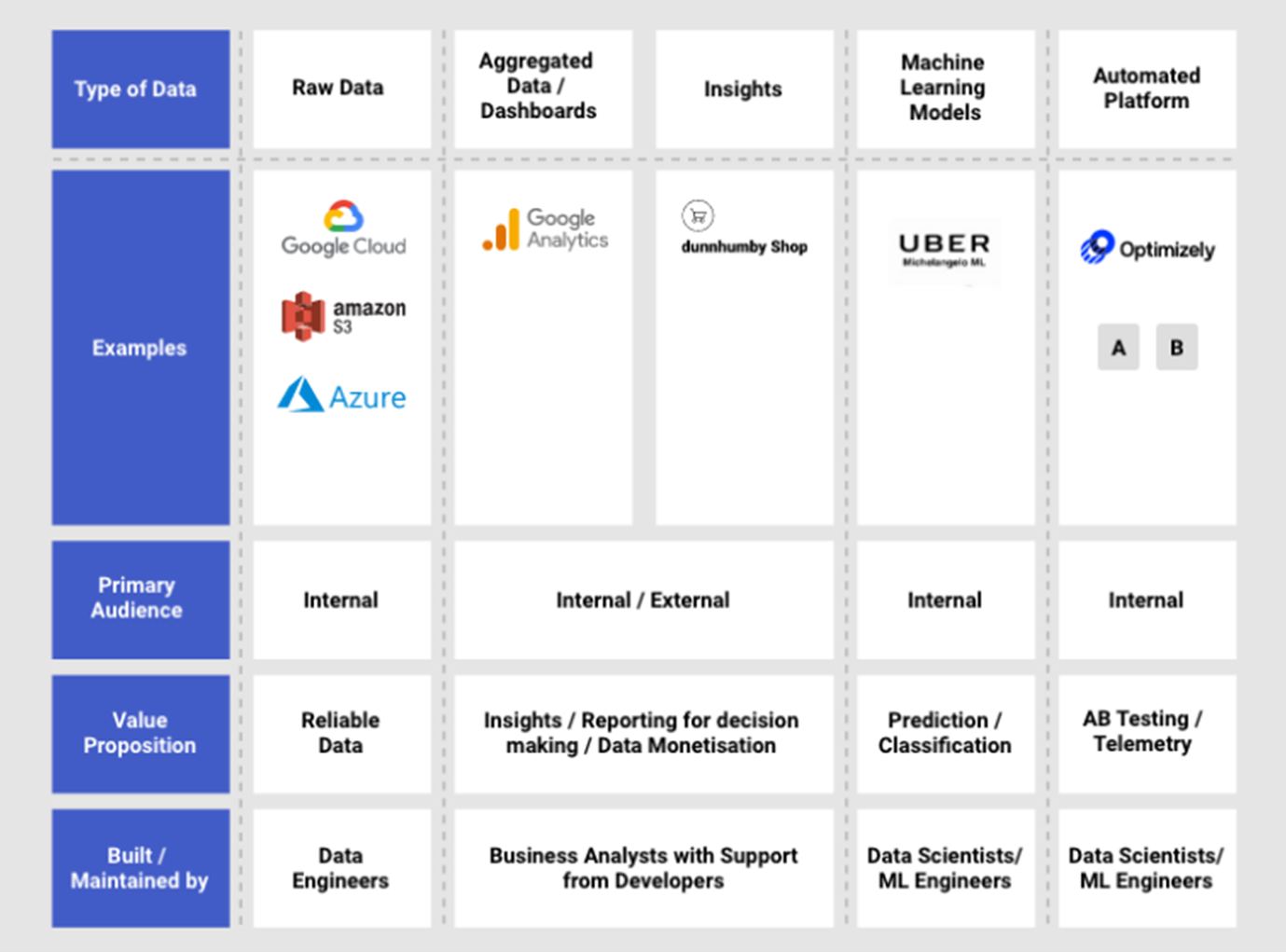
Today, wide variety of data products exist to cater to multiple use cases and internal and external audiences. These data products support the entire value chain from managing and structuring raw data to automated platforms for experimentation. The solutions are built and maintained by evolving job families of data engineers, machine learning (ML) engineers, and data scientists. Depending upon the use case, many of these data products are designed to be intuitive enough to be used by audiences without any data expertise.
A booming business landscape
Sensing the growing business demand for data products, the industry has seen a lot of action with the launch of new companies and products, increased venture capital funding and M&A activities. Some of the key areas of focus are data infrastructure, analytics platforms for Business Intelligence (BI) and data visualisation, ML and Artificial Intelligence (AI) platforms such as Google Cloud AI, and enterprise applications. A snapshot view of the complex ecosystem can be found here.
Source: Google ML Academy Webinar
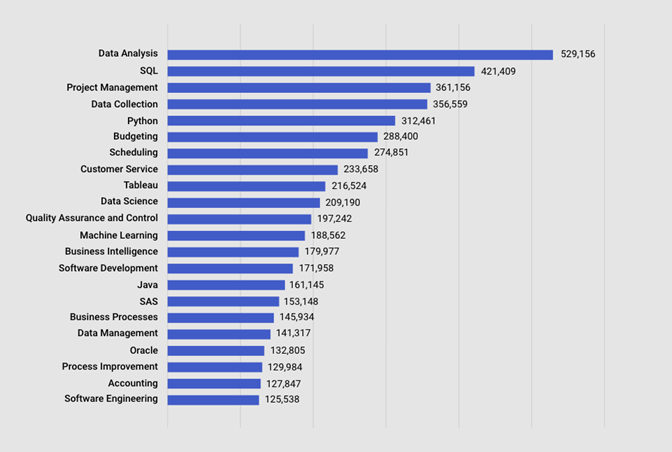
Given the scale of business opportunity, companies are increasingly competing for talent, and inevitably for data scientists and ML engineers. In many areas, demand is outstripping supply, resulting in wage inflation and scarce talent in the market.
Given the lucrative job market and an opportunity to learn these in-demand skills, there has been a significant increase in enrolment for courses related to data and ML skills across platforms such as Coursera.
Based on a survey of 85 Fortune 1000 firms by NewVantage Partners, less than 40% of the organisations surveyed agree that they are managing data as a business asset and create a data-driven organisation. Around 90% of predictive models built in labs never make it to the production environment.
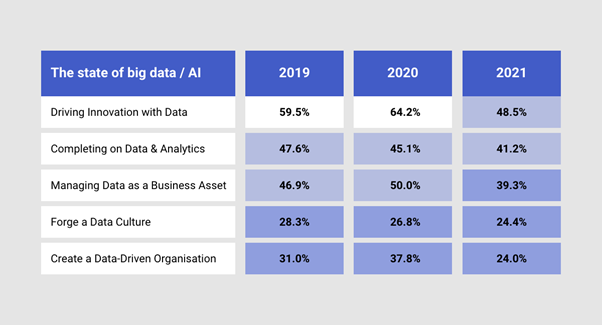
Source : Based on Survey of 85 Fortune 1000 firms by NewVantage Big Data and AI Executive Survey 2021
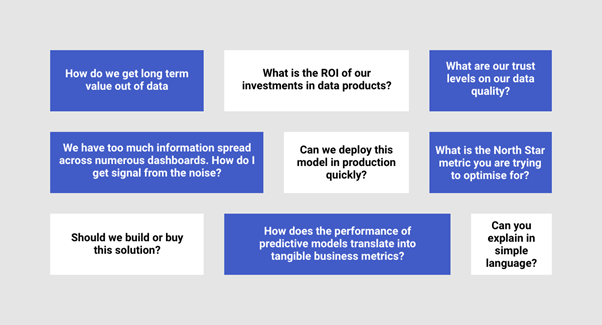
Given the big difference in the intent and the actual outcomes despite investments in data related infrastructure and talent, business stakeholders are asking the data and technology counterparts the right questions:
What can businesses do?
The starting point for organisations starting out in data products is to develop a nuanced understanding of the value chain of products. This often presents inherent challenges starting with an ill-defined business problem, but clearly defined success KPIs and benchmarks.
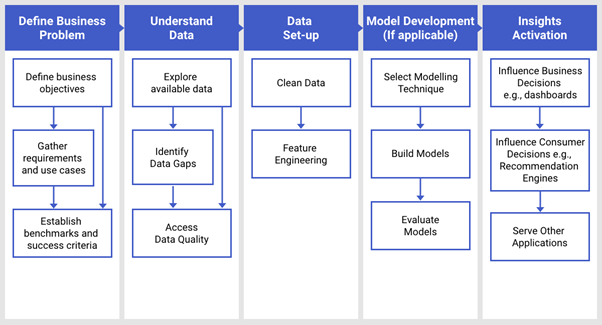
As an illustrative example consider the case of a hypothetical grocery delivery app where the business has identified an opportunity to improve customer experience via a personalised pre-populated grocery shopping list on the app. In order to be able to capitalise on this, the insight, business, data science, and technology teams need to be able to come together and answer the below questions even before they start building the solution:
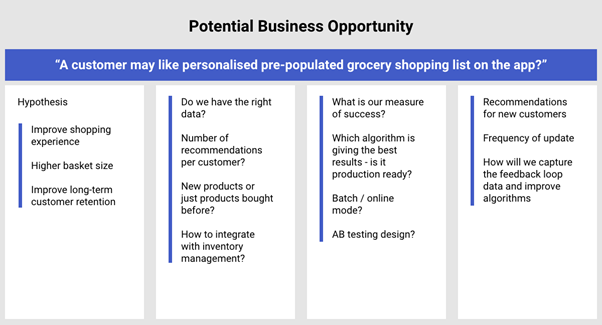
In absence of this rigorous thinking behind answering the above questions, it will be very difficult to get the right solution which works for the end-customers and the business.
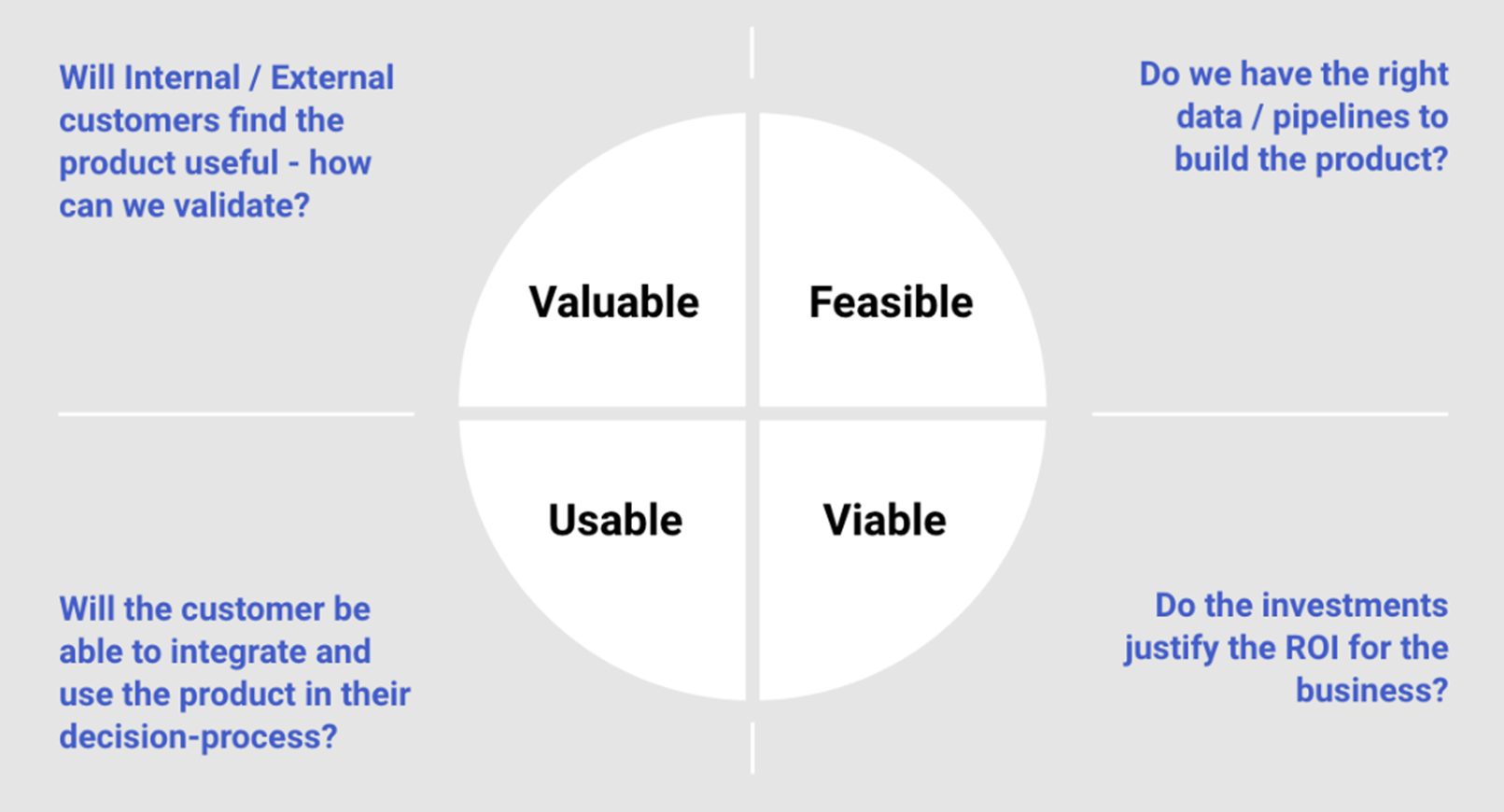
As depicted in the example below, businesses need to evaluate every data product with a multidimensional lens.
What does this mean for business and talent?
As the trend of using data and ML to enable business decision making and improve the customer experience unfolds, there are some key implications for professionals in this area as well as businesses investing in setting-up data and ML teams:

| Cookie | Description |
|---|---|
| cli_user_preference | The cookie is set by the GDPR Cookie Consent plugin and is used to store the yes/no selection the consent given for cookie usage. It does not store any personal data. |
| cookielawinfo-checkbox-advertisement | Set by the GDPR Cookie Consent plugin, this cookie is used to record the user consent for the cookies in the "Advertisement" category . |
| cookielawinfo-checkbox-analytics | Set by the GDPR Cookie Consent plugin, this cookie is used to record the user consent for the cookies in the "Analytics" category . |
| cookielawinfo-checkbox-necessary | This cookie is set by GDPR Cookie Consent plugin. The cookies is used to store the user consent for the cookies in the category "Necessary". |
| CookieLawInfoConsent | The cookie is set by the GDPR Cookie Consent plugin and is used to store the summary of the consent given for cookie usage. It does not store any personal data. |
| viewed_cookie_policy | The cookie is set by the GDPR Cookie Consent plugin and is used to store whether or not user has consented to the use of cookies. It does not store any personal data. |
| wsaffinity | Set by the dunnhumby website, that allows all subsequent traffic and requests from an initial client session to be passed to the same server in the pool. Session affinity is also referred to as session persistence, server affinity, server persistence, or server sticky. |
| Cookie | Description |
|---|---|
| passster | Set by Passster to remember that a visitor has entered a correct password, so they don’t have to re-enter it across protected pages. |
| wordpress_test_cookie | WordPress cookie to read if cookies can be placed, and lasts for the session. |
| wp_lang | This cookie is used to remember the language chosen by the user while browsing. |
| Cookie | Description |
|---|---|
| fs_cid | Set by FullStory to correlate sessions for diagnostics and session consistency; not always set. |
| fs_lua | Set by FullStory to record the time of the user’s last activity, helping manage session timeouts. |
| fs_session | Set by FullStory to manage session flow and recording. Not always visible or applicable across all implementations. |
| fs_uid | Set by FullStory to uniquely identify a user’s browser. Used for session replay and user analytics. Does not contain personal data directly. |
| VISITOR_INFO1_LIVE | Set by YouTube to estimate user bandwidth and improve video quality by adjusting playback speed. |
| VISITOR_PRIVACY_METADATA | Set by YouTube to store privacy preferences and metadata related to user consent and settings. |
| vuid | Vimeo installs this cookie to collect tracking information by setting a unique ID to embed videos to the website. |
| YSC | Set by YouTube to track user sessions and maintain video playback state during a browser session. |
| _ga | The _ga cookie, installed by Google Analytics, calculates visitor, session and campaign data and also keeps track of site usage for the site's analytics report. The cookie stores information anonymously and assigns a randomly generated number to recognise unique visitors. |
| _ga_* | Set by Google Analytics to persist session state. |
| _gid | Installed by Google Analytics, _gid cookie stores information on how visitors use a website, while also creating an analytics report of the website's performance. Some of the data that are collected include the number of visitors, their source, and the pages they visit anonymously. |
| _lfa | This cookie is set by the provider Leadfeeder to identify the IP address of devices visiting the website, in order to retarget multiple users routing from the same IP address. |
| __Secure-ROLLOUT_TOKEN | YouTube sets this cookie via embedded videos to manage feature rollouts. |
| Cookie | Description |
|---|---|
| aam_uuid | Set by LinkedIn, for ID sync for Adobe Audience Manager. |
| AEC | Set by Google, ‘AEC’ cookies ensure that requests within a browsing session are made by the user, and not by other sites. These cookies prevent malicious sites from acting on behalf of a user without that user’s knowledge. |
| AMCVS_14215E3D5995C57C0A495C55%40AdobeOrg | Set by LinkedIn, indicates the start of a session for Adobe Experience Cloud. |
| AMCV_14215E3D5995C57C0A495C55%40AdobeOrg | Set by LinkedIn, Unique Identifier for Adobe Experience Cloud. |
| AnalyticsSyncHistory | Set by LinkedIn, used to store information about the time a sync with the lms_analytics cookie took place for users in the Designated Countries (which LinkedIn determines as European Union (EU), European Economic Area (EEA), and Switzerland). |
| bcookie | LinkedIn sets this cookie from LinkedIn share buttons and ad tags to recognise browser ID. |
| bscookie | LinkedIn sets this cookie to store performed actions on the website. |
| DV | Set by Google, used for the purpose of targeted advertising, to collect information about how visitors use our site. |
| gpv_pn | Set by LinkedIn, used to retain and fetch previous page visited in Adobe Analytics. |
| lang | Session-based cookie, set by LinkedIn, used to set default locale/language. |
| lidc | Set by LinkedIn, used for routing from Share buttons and ad tags. |
| lidc | LinkedIn sets the lidc cookie to facilitate data center selection. |
| li_gc | Set by LinkedIn to store consent of guests regarding the use of cookies for non-essential purposes. |
| li_sugr | Set by LinkedIn, used to make a probabilistic match of a user's identity outside the Designated Countries (which LinkedIn determines as European Union (EU), European Economic Area (EEA), and Switzerland). |
| lms_analytics | Set by LinkedIn to identify LinkedIn Members in the Designated Countries (which LinkedIn determines as European Union (EU), European Economic Area (EEA), and Switzerland) for analytics. |
| lpv[AccountID] | This cookie is set by Salesforce Marketing Cloud Account Engagement. Prevents counting multiple page views within a short window to avoid duplicate tracking. |
| NID | Set by Google, registers a unique ID that identifies a returning user’s device. The ID is used for targeted ads. |
| OGP / OGPC | Set by Google, cookie enables the functionality of Google Maps. |
| OTZ | Set by Google, used to support Google’s advertising services. This cookie is used by Google Analytics to provide an analysis of website visitors in aggregate. |
| s_cc | Set by LinkedIn, used to determine if cookies are enabled for Adobe Analytics. |
| s_ips | Set by LinkedIn, tracks percent of page viewed. |
| s_plt | Set by LinkedIn, this cookie tracks the time that the previous page took to load. |
| s_pltp | Set by LinkedIn, this cookie provides page name value (URL) for use by Adobe Analytics. |
| s_ppv | Set by LinkedIn, used by Adobe Analytics to retain and fetch what percentage of a page was viewed. |
| s_sq | Set by LinkedIn, used to store information about the previous link that was clicked on by the user by Adobe Analytics. |
| s_tp | Set by LinkedIn, this cookie measures a visitor’s scroll activity to see how much of a page they view before moving on to another page. |
| s_tslv | Set by LinkedIn, used to retain and fetch time since last visit in Adobe Analytics. |
| test_cookie | Set by doubleclick.net (part of Google), the purpose of the cookie is to determine if the users' browser supports cookies. |
| U | Set by LinkedIn, Browser Identifier for users outside the Designated Countries (which LinkedIn determines as European Union (EU), European Economic Area (EEA), and Switzerland). |
| UserMatchHistory | LinkedIn sets this cookie for LinkedIn Ads ID syncing. |
| UserMatchHistory | This cookie is used by LinkedIn Ads to help dunnhumby measure advertising performance. More information can be found in their cookie policy. |
| visitor_id[AccountID] | This cookie is set by Salesforce Marketing Cloud Account Engagement. Unique visitor identifier used to recognize returning visitors and track their behavior. |
| visitor_id[AccountID]-hash | This cookie is set by Salesforce Marketing Cloud Account Engagement. Secure hash of the visitor ID to validate the visitor and prevent tampering. |
| yt-remote-connected-devices | YouTube sets this cookie to store the video preferences of the user using embedded YouTube video. |
| _gcl_au | Set by Google Tag Manager to store and track conversion events. It is typically associated with Google Ads, but may be set even if no active ad campaigns are running, especially when GTM is configured with default settings. The cookie helps measure the effectiveness of ad clicks in relation to site actions. |